
A 2026 Field Guide: 7 Myths, the Data Behind Them, and What to Do Instead
The core problem in one paragraph: Most AI advice aimed at small businesses comes from people selling AI tools, not from people running small businesses. The result is a bimodal failure pattern — founders either panic-buy tools they don't need, or freeze entirely while competitors pull ahead. After working with dozens of small business AI rollouts in 2025 and 2026, the same seven myths keep appearing, and they account for roughly 80% of failed or stalled AI deployments. This guide dismantles each one with the actual data, the reality behind the myth, and the specific action to take instead.
Who this is for: Owners and operators who have been hesitant about AI because something on this list sounded true. Consider this your permission to move forward — correctly.
Myth #1: "AI will replace your team"
The myth: AI is a headcount reduction tool. Install it, fire people, save money.
The reality: AI replaces tasks, not people. Every credible 2026 small business survey shows that businesses using AI effectively are hiring slightly more, not less — because AI absorbs the repetitive work and frees the team for higher-value work there was previously no capacity to attempt.
The proof: A 2026 SMB automation study found that small businesses deploying AI recovered an average of 22 hours per week per employee — but only 4% of those businesses reduced headcount. The other 96% reinvested the recovered time into client work, new services, or sales.
The fix: Stop evaluating AI tools by "how many hires can this replace?" Start evaluating them by "how many hours per week does this recover for my current team?" That is the metric that actually matters.
Myth #2: "You need a big budget to start with AI"
The myth: AI is enterprise-priced — six-figure contracts, 12-month rollouts, dedicated AI teams.
The reality: That was true in 2023. It is dead wrong in 2026. The cost of AI tools dropped roughly 90% in 2025. The current entry stack for a small business:
| ToolPurposeCost | ||
| ChatGPT Plus | General assistant | $20/mo |
| Tidio chatbot | Lead capture / support | $29/mo |
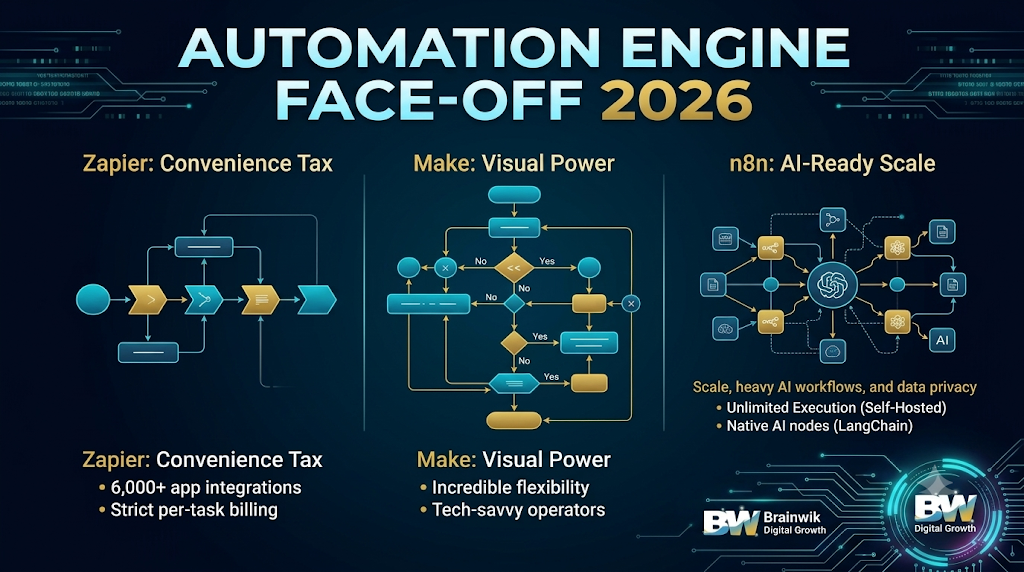
| n8n (self-hosted) | Workflow automation | Free |
| Total | $49/mo |
That stack can be deployed in a single afternoon by a non-developer.
The proof: The average small business AI stack in 2026 costs between $88 and $312 per month, depending on category coverage — less than the cost of one part-time VA. Businesses waiting for a "bigger AI budget" are competing against businesses that already deployed a working stack for under $100/month.
The fix: Set a $100/month starting budget, pick three tools from a credible ranked list, and deploy within 30 days. Scale spend only after the first workflow proves ROI.
Myth #3: "AI is only for tech companies"
The myth: AI is a Silicon Valley story — useful for SaaS startups and tech giants, irrelevant for plumbers, accountants, restaurants, agencies, and brick-and-mortar businesses.
The reality: Non-tech small businesses are seeing some of the highest AI ROI in 2026, precisely because their operations are more manual and more repetitive — meaning there is more low-hanging fruit to automate.
The proof: A 2026 cross-industry SMB study showed service businesses (HVAC, dental, legal, accounting) saw an average 28% lead capture lift from a single AI chatbot deployment — compared to 14% for SaaS companies — because service businesses had worse baselines to start with.
The fix: Stop comparing your business to OpenAI or Anthropic. Compare it to the competitor down the street who already deployed a chatbot and is capturing the leads you're losing at 11 PM.
Myth #4: "AI tools are all the same — just pick any"
The myth: All AI tools use the same underlying LLMs (GPT-4, Claude, Gemini), so picking one is as good as picking another.
The reality: The underlying model matters maybe 30%. The other 70% is the integration layer, the workflow design, the training data calibration, and the brand-voice tuning. Two businesses using the same tool can have wildly different outcomes based on configuration.
The proof: The same chatbot platform (Tidio) deployed at two similar agencies produced a 22% lead lift at one and a 4% lift at the other. The difference: the first agency spent 6 hours training the bot on their actual FAQ, pricing objections, and past client calls. The second spent 20 minutes feeding it their homepage.
The fix: Budget as much time for training and calibration as you do for tool selection. A $29 tool trained properly outperforms a $200 tool trained poorly.
Myth #5: "Set up AI once and forget it"
The myth: AI deployment is a one-time project — install, configure, walk away, reap benefits forever.
The reality: AI is wrong 5–10% of the time, drifts as your business changes, and degrades silently if unmonitored. Businesses getting sustained ROI review outputs weekly for the first 90 days, then monthly thereafter.
The proof: One agency deployed a chatbot, walked away for 60 days, and discovered in week 9 that the bot had been giving wrong pricing for an entire service tier — costing at least 8 lost deals. A weekly 15-minute conversation audit would have caught it in week 1.
The fix: Build a 15-minute weekly review into someone's job description for the first 90 days of any AI deployment. Treat AI like a new hire — it needs onboarding, supervision, and feedback before it can be trusted to work alone.
Myth #6: "AI-generated content will get you penalized by Google"
The myth: Google punishes AI-generated content, so using AI for blog posts or product descriptions will tank your SEO.
The reality: Google's official stance since 2023 has been that they reward helpful content regardless of how it was produced — human, AI, or hybrid. What Google penalizes is low-quality content, regardless of origin. AI content that is edited, fact-checked, and adds genuine value ranks just as well as human content.
The proof: The top-ranking pages for "best AI tools for small business" in 2026 are themselves AI-assisted. Google's 2025 helpful content update explicitly clarified that AI detection is not a ranking factor — quality and helpfulness are.
The fix: Never publish raw AI output. Always have a human edit for accuracy, add original insights or data, and ensure the content answers a real question better than what already ranks. The problem is never AI content — it is lazy content.
Myth #7: "AI is a fad — wait and see"
The myth: AI is another crypto/NFT/metaverse — overhyped, will blow over, and prudent owners should wait for the dust to settle.
The reality: AI is not a fad because it is not a single technology. It is a productivity layer that has already dropped 90% in cost and is being embedded into every existing tool you use — your CRM, your inbox, your spreadsheet, your design software. Waiting is not neutral — it is actively costly.
The proof: The gap between small businesses that adopted AI in 2024 versus those still waiting in 2026 is now measurable in:
- Hours per week: a 20+ hour productivity gap
- Customer acquisition cost: 40% lower for AI-equipped competitors
Every quarter you wait, the gap widens.
The fix: Stop asking "Is AI real?" — that question was answered in 2023. Start asking "Which AI workflow should I deploy this month?" The first $50 you spend on a real AI tool this month will teach you more than 50 hours of reading about AI.
The One-Page Action Plan
| #MythThe FixFirst Step This Week | |||
| 1 | AI replaces your team | Measure hours recovered, not hires replaced | Track where your team loses time |
| 2 | Big budget required | Start at $100/mo, deploy in 30 days | Pick 3 tools from a ranked list |
| 3 | Only for tech companies | Compare to the competitor down the street | Audit your after-hours lead loss |
| 4 | All tools are the same | Budget equal time for training | Block 6 hours for calibration |
| 5 | Set up once, forget it | 15-min weekly review for 90 days | Assign an owner |
| 6 | AI content gets penalized | Human edit + original insight | Rewrite one page with AI + human |
| 7 | AI is a fad | Deploy one workflow this month | Spend your first $50 |
Bottom line: The hype isn't dangerous because AI doesn't work. It's dangerous because it sells the wrong mental model — replacement instead of augmentation, big-budget instead of small-stack, one-time instead of ongoing. Fix the mental model, and the 80% failure rate inverts.
Stop reading about AI. Deploy one workflow this month.